
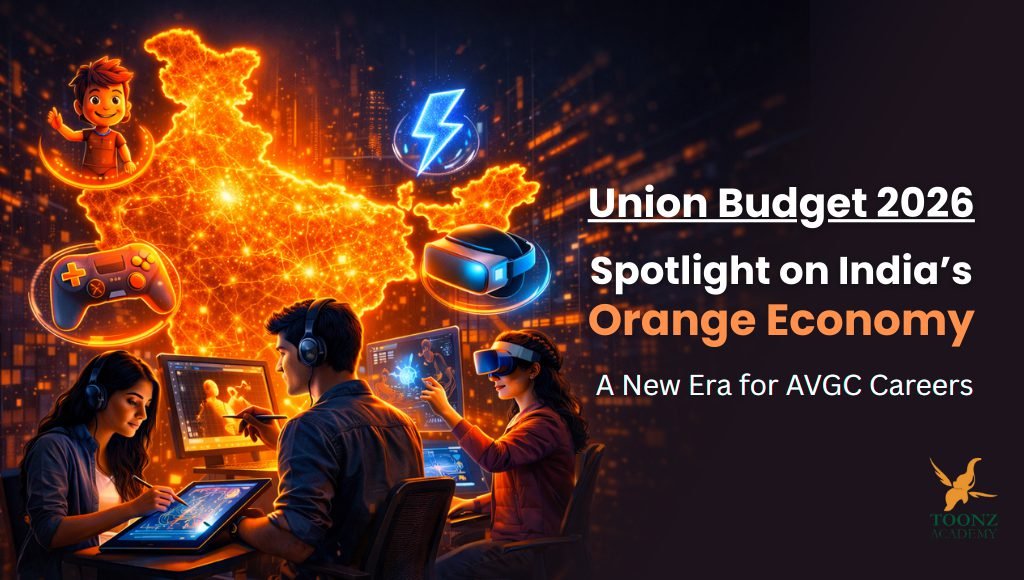
India’s creative industries have officially stepped into the economic mainstream.
With the Union Budget 2026–27, Finance Minister Nirmala Sitharaman placed strong emphasis on the “Orange Economy”, recognising creativity, digital capability, intellectual property, and cultural innovation as vital economic assets.
This move is not just symbolic. It signals a structural shift in how India views animation, VFX, gaming, comics, and digital design — positioning them as key drivers of employment, exports, and future-ready skills.
More than a policy announcement, it reflects a long-term vision that opens new doors for aspirants, studios, creators, and global collaborations.
What Is the Orange Economy — and Why It Matters Now
The Orange Economy refers to industries built on creative talent and ideas, including:
- Animation & Visual Effects (VFX)
- Gaming & Interactive Media
- Comics & Digital Storytelling
- Design, Motion Graphics & UI/UX
- AR, VR & immersive experiences
Unlike factory-driven sectors, these industries grow through skills, storytelling, technology, and global digital demand — making them ideal for a young, tech-savvy country like India.
By recognising the Orange Economy at a national policy level, the government has acknowledged that creative careers are no longer “alternative” careers — they are mainstream economic opportunities.
Why This Is a Game Changer for AVGC
1.AVGC Steps into the Mainstream Economy
For a long time, animation and gaming operated in the background of films, OTT platforms, YouTube, and international studios. With Budget 2026, these sectors are now part of India’s official development framework.
This means:
- Stronger Institutional Involvement
- Structured Skilling Systems
- Stronger industry-academia alignment
- Higher Credibility for Creative Professions
For aspiring students and their parents, the uncertainty around creative careers is steadily being replaced with trust as a long term profession.
2. Strengthening Talent Pipelines in AVGC
A key takeaway from the budget is its focus on building a skilled creative workforce.
India’s AVGC sector is projected to require millions of skilled professionals in the coming years, across:
- 2D & 3D Animation
- VFX & Virtual Production
- Game Art & Game Design
- Motion Graphics & Digital Design
- AR/VR Content Creation
Union Finance Minister Nirmala Sitharaman highlighted the rapid expansion of India’s animation, visual effects, gaming, and comics ecosystem, noting that the sector is expected to generate demand for nearly two million skilled professionals by the end of this decade. To build this talent pipeline, the government announced support for the Indian Institute of Creative Technologies (IICT), Mumbai, with plans to establish AVGC content creator labs across 15,000 secondary schools and around 500 colleges nationwide.
This approach directly supports multimedia institutes that focus on industry-aligned creative education.
3. Early Exposure to Creative Technologies
The initiative aims to provide early exposure to creative technologies at both school and college levels and hands-on digital skills, strengthening India’s position in the global creative economy.
This changes how careers are discovered:
- Students explore animation, gaming, and design before choosing a degree
- Creativity becomes a skill, not just a hobby
- Career decisions become informed, not accidental
This foundation is key to building world-class creators who understand both storytelling and technology.
The Role of AVGC in Shaping India’s Future Workforce
The scope of AVGC careers has expanded significantly in recent years. Global studios, OTT platforms, game publishers, and technology companies are increasingly dependent on animation, VFX, game assets, and immersive content. Since these roles combine creativity with technology, careers within the Orange Economy are well protected against automation and future job disruptions.
What This Means for Students Choosing Creative Careers
If you’re planning your career after 12th grade, Budget 2026 makes one thing clear: skill-based careers are the future.
Animation, VFX, gaming, motion graphics, and AR/VR have opened doors to::
- Diverse job roles
- Freelance & global opportunities
- Studio, OTT, gaming, and tech careers
- Scalable income paths
With proper training and industry exposure, these creative fields provide long-term stability along with creative satisfaction.
How Professional Training Becomes Even More Important
As the Orange Economy continues to expand, competition within the creative industry is also increasing. Employers today evaluate candidates based on practical abilities rather than academic qualifications alone. Studios focus on what candidates can deliver production-ready skills, well-curated portfolios, understanding of professional pipelines, and practical experience. This makes specialised training institutes in animation, VFX, design, AR/VR, and gaming vital in preparing students to become employable professionals.
A New Chapter for Creative Careers in India
Creative careers are no longer peripheral—they are central to economic growth. The government has placed creativity, intellectual property, and digital skills at the centre of national development.
With the Orange Economy receiving national recognition, animation, VFX, gaming, and digital design have officially moved from passion-driven choices to future-proof professions. India’s future will not be shaped by machines alone, but by storytellers, designers, and technologists who bring ideas to life.
For AVGC aspirants, this is no longer a leap of faith—it is a calculated, confident career move.